

Along a quiet stretch of the historic National Road in Fayette County, travelers pass a modest stone monument beside the highway. Few realize they are passing over a place where one of the most dramatic moments in early American history unfolded—a moment when empire, ambition, and the wilderness collided. This is the story of Braddock’s Grave, the final resting place of British General Edward Braddock., and strangely enough, it is also the place where America’s first great highway quite literally runs over the dead.
A Road Cut Into the Wilderness
The year was 1755. The British Empire was determined to seize control of the Ohio Valley from France during the growing conflict that would become the French and Indian War. To accomplish this, the Crown sent General Edward Braddock (an experienced but rigid officer of the British Army) to march west and capture the French stronghold at Fort Duquesne, where the Allegheny and Monongahela Rivers meet. However, between Braddock and his objective stood a vast barrier of mountains and forest.
There was no road. So Braddock ordered one built.
His soldiers, engineers, and laborers hacked their way across the wilderness, cutting a rough military corridor through the dense Appalachian forest. Wagons followed. Cannon rolled forward. The road widened with every mile. This crude military trail (known simply as Braddock’s Road) would become one of the earliest engineered routes across the frontier. At the time, no one could have imagined it would one day evolve into the backbone of America’s first federal highway.
Disaster in the Forest
On July 9, 1755, just miles from Fort Duquesne, Braddock’s army marched confidently through the woods along the Monongahela River. The British soldiers wore bright red coats. Their cannons rumbled behind them. Their drums echoed through the trees.
Then the forest exploded.
French soldiers and Native warriors emerged from the shadows. Gunfire erupted from every direction. The disciplined European formations—so effective on open battlefields—became chaos in the tangled wilderness. Officers shouted orders that no one could hear. Horses panicked. Smoke filled the woods.
This brutal ambush became known as the Battle of the Monongahela. In less than three hours, Braddock’s army was shattered. Nearly two-thirds of the force were killed or wounded and General Braddock himself was struck by a musket ball that tore through his chest.
The Retreat
The surviving British soldiers fled east along the road they had cut into the wilderness only weeks before. Among them rode a young Virginian officer who had miraculously survived the battle despite having multiple horses shot from beneath him.
His name was George Washington.
For four agonizing days, the army carried the wounded general through the mountains. Braddock knew he would not survive. On July 13, 1755, somewhere along the retreat route near present-day Fayette County, the general died.
A Grave Hidden Beneath the Road
Washington feared that if French or Native forces discovered the general’s body, they would desecrate it as a trophy of victory. So he made an unusual decision.
The soldiers dug a grave in the middle of the road itself.
Braddock’s body was lowered into the earth.
Then the army marched their wagons, horses, and soldiers directly over the grave obliterating any sign of where he had been buried.
The wilderness swallowed the secret. For nearly seventy years, the grave’s exact location remained unknown.
When America Built a Highway
Decades passed.
The French and Indian War ended.
The American Revolution reshaped the continent.
The young United States began pushing westward.
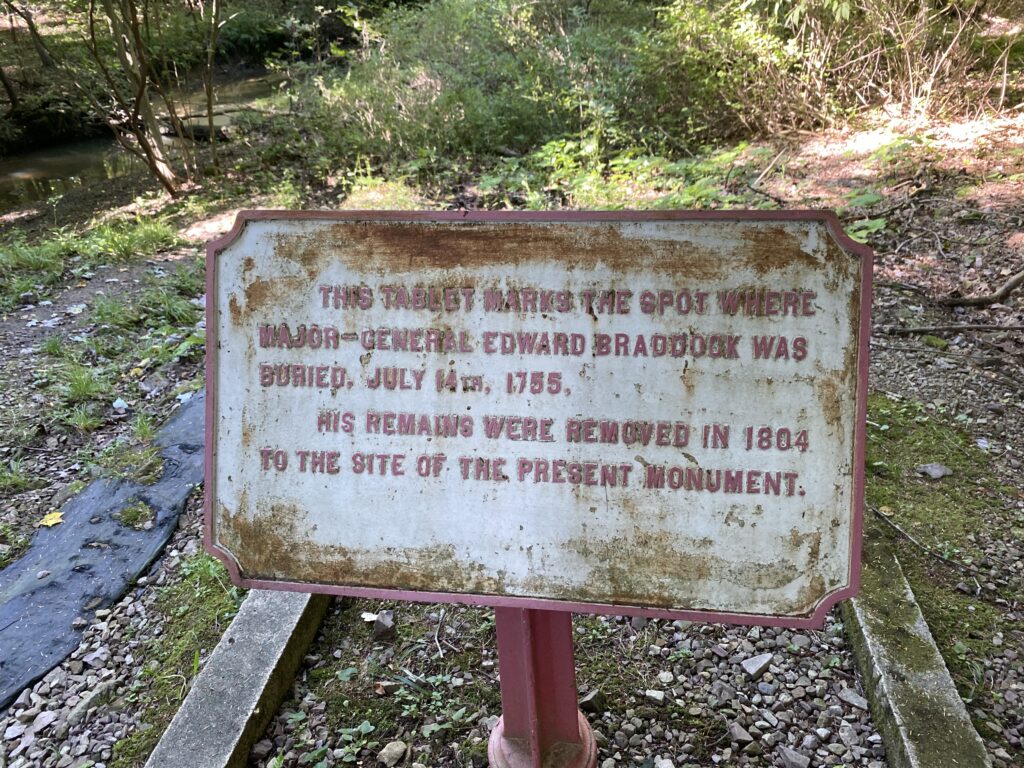
In 1806, Congress authorized construction of the nation’s first great federal highway the National Road. Surveyors searching for a route through the mountains discovered something remarkable:
The easiest path west was the same corridor first carved by Braddock’s army. Construction crews followed the old military road. In 1823, while working near Mount Washington in Fayette County, they uncovered human remains beneath the roadway.
They had rediscovered the long-lost grave of General Braddock.
His remains were respectfully reburied beside the highway, where a monument still stands today.
A Road Built on History
The highway that eventually passed the grave became the legendary National Road, the gateway through which thousands of settlers, wagons, and stagecoaches traveled toward the American frontier. Today that same route is known as U.S. Route 40. Drivers pass the site every day often without realizing they are traveling along the very path where:
- A British army marched into the wilderness.
- A devastating battle reshaped colonial warfare.
- The grave of a fallen general was once hidden beneath the road itself.
Where Empire, War, and the Frontier Meet
Braddock’s Grave is more than a burial site. It represents a crossroads in American history.
Here, three great stories intersect:
- The violent struggle between European empires for control of North America.
- The early military experiences of George Washington.
- The birth of America’s first national highway.
The road that once carried an army into disaster later carried a nation westward.
Beside that road, under the quiet hills of Fayette County, lies the grave of the man whose march unknowingly helped create it.